
Final Automata – Overview
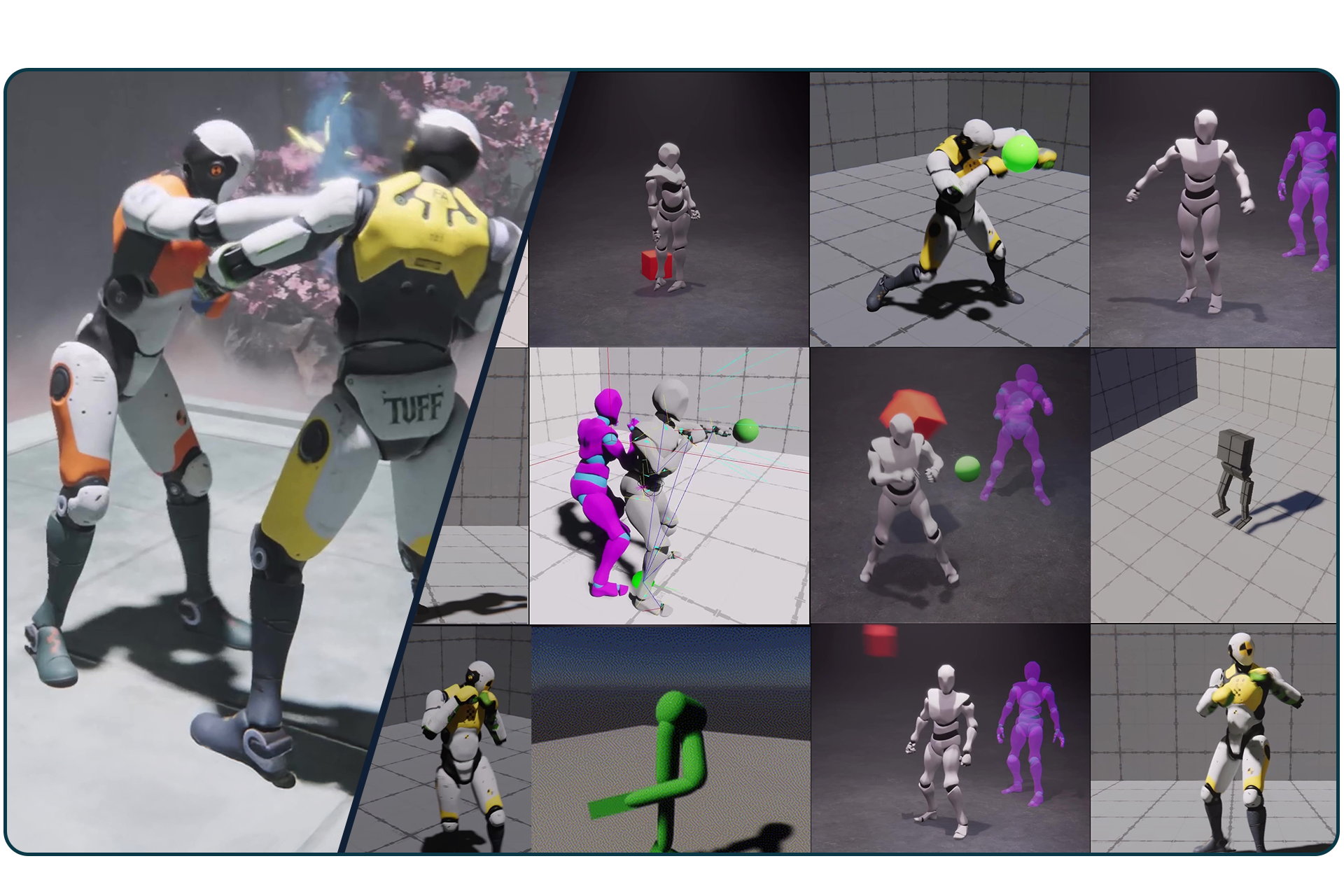
Final Automata started as a spectator experience: fully simulated robots fighting in a physically realistic arena. It quickly evolved into one of the most challenging autonomy projects we have worked on.
At its core, Final Automata is a high dimensional control problem. Each fighter is a bipedal robot driven by reinforcement learning policies that must:
- Stay balanced and mobile
- Execute realistic martial arts movements
- Adapt strategy against a changing, adversarial opponent
- Do all of that in real time in a physically based environment
This combination of high level strategy and low level control is exactly the kind of problem that appears in many real-world autonomy and robotics applications.
Today, Final Automata serves as a training ground for our autonomy and simulation expertise. In the long term it can grow into a full esports-style experience, but right now its main value is as a research and prototyping platform for difficult reinforcement learning problems.
Currently the system supports one martial art style with roughly 40 reusable skills. The roadmap includes dozens of styles and more than one hundred unique movements per fighter.
Tech stack
- Unity Engine
- High Definition Render Pipeline
- Unity ML-Agents framework
- PyTorch based training stack with protobuf and gRPC under the hood
- Training across various hardware: CPU, GPU, Nvidia, Apple Silicon
- Data oriented design and custom optimizations in the hot paths of the RL loop
Skill hierarchy
The agent’s behavior is organized as a hierarchy of skills. At a high level, the controller reasons about intent and timing. At a lower level, it selects and blends motion primitives while staying physically stable.
Skill groups include:
- Locomotion – approximately 20 independent movements for stepping, circling, entering and exiting range.
- Blocking and defense – around 12 skills for covering different attack lines, reacting to incoming strikes, and controlling distance.
- Striking – currently about 10 core strikes, with a roadmap toward around 100 unique offensive movements with variations in angle, speed, and setup.
This hierarchy mirrors many real autonomy problems where you need both a library of low level maneuvers and a high level policy that knows when and how to use them.
Long horizon decision making
The adversarial nature of fighting is what makes this environment especially interesting for decision making.
The agent is not just trying to execute a single optimal move. It needs to:
- Reason over long horizons under uncertainty
- Evaluate tradeoffs between aggression and safety
- Choose sequences of actions that remain physically plausible and visually convincing to a human observer
Pre-simulating all possible futures is intractable in real time. Instead, the policy must learn an internal sense of value for each state, and use that to guide decision making under uncertainty. This is directly relevant to any autonomous system operating in dynamic, partially unpredictable environments.
Key technical challenges and how we address them
RL is hard to debug
Agents can happily learn in a broken environment with no explicit error messages. The only symptom is a policy that behaves strangely. We deal with this through:
- Extensive observation and action logging
- Visual debugging tools and Unity Gizmos
- Systematic simplification of the training pipeline so that bugs have fewer places to hide
Sample efficiency and throughput
Reinforcement learning is sample hungry. We invest time into:
- Optimizing the simulation loop and physics
- Efficient reward computation
- Data oriented animation and contact handling
This leads to higher throughput in environment steps per second, which directly reduces training time.
Reward shaping and unintended behavior
Naive reward functions tend to reinforce every action in a successful trajectory, which can produce odd or undesirable behaviors. We iterate heavily on reward design and introduce structure that encourages:
- Natural looking movement
- Clean, interpretable strategies
- Robustness instead of fragile exploits
How this expertise transfers to your project
Final Automata is a showcase environment, but the underlying skills are directly applicable to real projects.
We can help with:
Autonomy and control
- Navigation in complex environments
- Reactive decision making under uncertainty
- Long term planning and execution in adversarial or safety critical contexts
Simulation and digital twins
- High performance simulation design
- Data oriented optimization and profiling
- Building simulation environments that are useful for both training and validation
World modeling and RL pipelines
- Designing observation spaces and action spaces that match your hardware and sensors
- Structuring hierarchies of skills and controllers
- Setting up training pipelines, from environment design to logging and evaluation
We see Final Automata as one concrete example of a more general principle: as DeepMind and others have demonstrated, progress in autonomy and decision making comes from mastering complex artificial environments. Our work focuses on building these environments and the agents that can thrive in them.
If you have a project involving reinforcement learning, autonomous agents, or simulation and would like help designing or implementing it, Final Automata gives you a very concrete demonstration of what we can deliver.